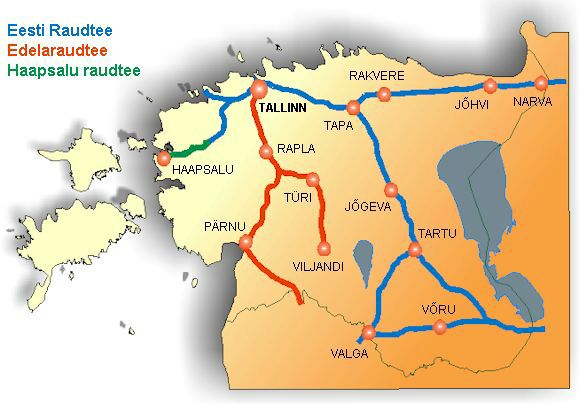

Eesti Raudtee (Estonian Railways)
Freight
Exited | 9-Jan-2007
Fast Facts
693
26.1 million
431
98
3,405
Oil, coal, grain fertilizer, containers, timber
Background
In 1870, the first railway in Estonia was opened between Paldiski - Tallinn - Narva - Gatchina, connecting with the St. Petersburg - Warsaw railways. In 1931 the Tartu-Petseri broad gauge railway was completed, linking the Estonian ports with the interior of Russia and Ukraine. In 1992 the state-owned Eesti Raudtee ("EVR") was established from the former Baltic Railways administration of Soviet Railways. EVR owns and operates approximately 500 miles (693 km) of five-foot gauge railway. EVR handles an annual average of 40 million tons of freight, with its major cargo being Russian petroleum products moving in unit trains to the ice-free Estonian ports on the Baltic Sea. Independent operators provide passenger service using EVR's infrastructure under access agreements.
In 1997 EVR prepared for a reorganization and privatization plan to transfer operations not connected with its main line of business. Thus, EVR Ekspress was established to operate international passenger traffic between Estonia and Russia; Elektriraudtee operates Tallinn commuter trains on electrified lines; and Edelaraudtee operates all other internal passenger traffic with diesel trains and railroad freight on the Tallinn-Pärnu-Mõisaküla and Lelle-Viljandi lines.
On August 31, 2001 Baltic Rail Services ("BRS") purchased a controlling 66% interest in EVR. BRS investors included Rail World Inc. (USA); Emerging Europe Infrastructure Fund (UK); Ganiger Invest OÜ (Estonian entrepreneurs); RDC; and until 2003 Jarvis Estonia BV (UK). The Estonian government held the remaining 34% interest in EVR.
On January 9, 2007 EVR was re-nationalized when BRS completed the sale of its 66% interest back to the Estonian government, ending over five years of private sector management.